Contents
- 1 Affiliate Marketing Mistakes to Avoid Early On
- 2 Starting With the Right Foundations
- 3 Creating Content That Builds Trust and Sales
- 4 Avoiding SEO Mistakes That Limit Free Traffic
- 5 Not Relying on One Traffic Source
- 6 Tracking What Leads to Clicks and Commissions
- 7 Protecting Trust With Transparency and Good Practice
- 8 Frequently Asked Questions
- 8.1 What are the most common reasons affiliate links fail to convert on a website?
- 8.2 How can you choose affiliate products that genuinely match your audience’s needs?
- 8.3 What compliance steps should you take to disclose affiliate relationships correctly in the UK?
- 8.4 What do you need to qualify for the Amazon Associates programme?
- 8.5 How many followers or how much traffic do you typically need before applying to Amazon Associates?
- 8.6 Which WordPress and WooCommerce plugins are most reliable for managing Amazon affiliate links?
Affiliate Marketing Mistakes to Avoid Early On
Affiliate marketing mistakes cost beginners more time, money, and motivation than most people expect. The concept sounds straightforward: recommend a product, share a link, and earn a commission. In practice, the gap between signing up for an affiliate program and generating consistent affiliate income is where most newcomers stumble.
The good news is that nearly every common affiliate marketing mistake is avoidable once you know what to look for and why it matters. Whether you pick the wrong niche, ignore SEO, rely on a single traffic source, or skip proper tracking and analytics, each error has a direct impact on your affiliate revenue.
This guide walks you through the mistakes that trip up beginners most often. More importantly, it connects the dots between your niche selection, content strategy, search engine optimisation, traffic sources, and compliance so you can see how each piece feeds into the next. When you treat affiliate marketing as a connected system rather than a collection of separate tasks, you build results that compound over months instead of flatlining after weeks.
Key Takeaways
- Choosing a sustainable niche and the right affiliate programs with a clear commission structure sets the foundation for everything else you do.
- Creating helpful content, optimising it for search engines, and diversifying your traffic sources are the three levers that drive consistent clicks and conversions.
- Tracking your click-through rates, conversion rates, and affiliate revenue from day one lets you fix problems early and grow faster.
Starting With the Right Foundations
Your niche, your affiliate programs, and your understanding of how tracking and payouts work all shape every decision that follows. Get these wrong early on, and even great content or strong traffic will not translate into reliable affiliate income.
Choosing a Niche You Can Actually Sustain
One of the most common affiliate marketing mistakes is picking a niche based purely on commission rates. High payouts mean nothing if you cannot write about the topic consistently for months.
Choose a niche where three things overlap: genuine interest or experience, a real audience with purchasing intent, and a manageable level of competition. A narrow sub-niche often works better at the start because it is easier to build authority before expanding.
Validate your niche before committing. Search for buyer-intent keywords in your topic area and check whether there is enough search volume to support ongoing content. If you land in the wrong niche, you will burn months creating content that attracts visitors who never buy.
Picking the Right Affiliate Program and Commission Model
Not every affiliate program is worth your time. Compare the commission structure, cookie duration, and payment terms across affiliate networks before you sign up. A programme with a lower payout but a 30-day cookie and strong conversion rate can easily outperform one with a higher headline commission that converts poorly.
Look at what each affiliate network offers in terms of support. A responsive affiliate manager, solid reporting dashboards, and clear programme terms save you headaches later. Read the terms of service carefully; some programmes restrict how you can promote products, and breaking those rules can get your account closed.
Understanding How Sign-Up, Tracking and Payouts Work
Before you start promoting anything, understand the full cycle: sign-up form, affiliate tracking, conversions, and payment.
When someone clicks your affiliate link, a cookie is placed on their device. That cookie tracks whether they complete a purchase within a set window. If they do, you earn a commission. If the cookie expires first, you earn nothing.
Set up your affiliate tracking correctly from day one. Confirm that your links are working, that clicks register in your dashboard, and that you know when and how you get paid. Small oversights here, like broken links or incorrect tracking IDs, quietly drain your affiliate revenue without you realising.
Creating Content That Builds Trust and Sales
Your content strategy determines whether visitors click your affiliate links or leave your site. The most effective affiliate promotions come from content that genuinely helps the reader, not content that reads like an advert.
Why Overly Promotional Content Often Fails
Promotional content that pushes products in every paragraph turns readers away. People can spot a hard sell quickly, and when every sentence sounds like a pitch, trust evaporates.
The fix is simple. Lead with useful information. Answer the questions your audience is already asking, and weave product recommendations into that context naturally. Bloggers who share specific observations, mention real drawbacks, and explain who a product is not suitable for tend to see a much higher conversion rate than those who only list benefits.
Matching Content Types to Search Intent
Different searches call for different content types. Someone searching “best budget running shoes” wants a comparison. Someone searching “how to clean running shoes” wants a tutorial. Matching your content to search intent is one of the easiest ways to improve conversions.
Use a mix of formats:
- Product comparisons for people ready to buy
- How-to guides that solve a problem and mention relevant tools
- Evergreen content that stays useful for months or years
- Images and videos that show products in real-world use
When your content matches what the reader actually needs, click-through rates go up without any extra pressure.
Using CTAs Without Sounding Pushy
A good call to action tells the reader what to do next without making them feel cornered. Phrases like “check the current price” or “see the full specs here” work better than “buy now before it’s gone.”
Place your CTA where it fits the natural flow of the content. After a detailed product breakdown or a direct answer to a reader’s question is usually the right spot. Keep your language calm and specific. One well-placed, relevant CTA will outperform five aggressive ones scattered through a page.
Avoiding SEO Mistakes That Limit Free Traffic
Search engine optimisation is the primary way most affiliate sites earn consistent organic traffic. If you ignore SEO, you are left relying on social media algorithms or paid ads, both of which can disappear overnight.
Skipping Keyword Research and Topic Selection
Publishing content without keyword research is one of the most expensive affiliate marketing mistakes you can make. You might write a brilliant article that nobody ever finds because no one searches for that phrase, or because the competition is far too strong for a new site.
Start with long-tail keywords that show buyer intent. These are phrases like “best noise-cancelling headphones under 100” rather than just “headphones.” They attract smaller but more targeted audiences, and they are far easier to rank for when your site is new.
Use free tools like Google Search autocomplete and “People Also Ask” boxes to find related topics. Build a list of 20 to 30 keywords before you write a single post.
On-Page Fixes Beginners Often Miss
Small on-page optimisation details add up. Here are the most common issues:
- Title tag does not include the target keyword or is over 60 characters
- Meta description is missing or generic, which hurts click-through rates in Google Search results
- Headings are not structured logically (H2, H3) or do not reflect the content beneath them
- Images lack descriptive alt text
Fix these before you hit publish. They take minutes to get right and can make the difference between page one and page three.
Building Internal Links and Topical Depth
Internal links connect your content together and help search engines understand your site’s structure. Every new post should link to at least two or three related articles on your site, and older posts should be updated to link to newer ones.
Topical depth matters too. A site with ten thorough articles on one focused topic will typically outrank a site with fifty shallow posts spread across a dozen topics. This is where your content strategy and SEO strategy overlap. Plan clusters of related content around your core niche, and link them together.
Not Relying on One Traffic Source
Depending on a single traffic source is a risk that catches many beginners off guard. Algorithm changes, account bans, or shifting ad costs can cut your affiliate revenue to zero overnight if you have no backup.
The Risk of Depending Only on Google
Organic traffic from Google Search is powerful, but it is not guaranteed. A single algorithm update can drop your rankings significantly. If 100% of your traffic comes from search engine traffic, one bad month can wipe out your affiliate income.
The solution is not to avoid Google. It is to make sure Google is not your only channel. Treat organic traffic as your foundation, then build additional traffic sources on top of it.
Using Email Marketing to Own Your Audience
An email list is the one traffic source you fully control. Social platforms can change their rules, and search rankings can shift, but your email list stays with you.
Add a simple sign-up form to your site offering something genuinely useful, like a short guide or a checklist related to your niche. Then send regular emails with helpful content and occasional affiliate promotions. Even a small email list of a few hundred engaged subscribers can generate meaningful direct traffic and conversions.
When Paid Ads Make Sense for Beginners
Paid ads are not usually the best starting point. The maths needs to work: your commission per sale must comfortably exceed your cost per click. For most beginners, the margins are too thin and the learning curve is too steep.
That said, paid ads can make sense in specific situations:
- You are promoting a high-ticket product with a generous commission structure
- You have tested a landing page that already converts well from organic traffic
- You have a clear budget limit and a way to track ROI accurately
If none of those apply, focus on content and SEO first. Come back to paid ads once you have data to guide your spending.
Tracking What Leads to Clicks and Commissions
Without tracking and analytics, you are making decisions based on guesses. Knowing which pages drive clicks, which products convert, and where your traffic comes from is what separates affiliates who grow from those who plateau.
Metrics That Matter More Than Raw Traffic
Raw traffic numbers feel encouraging, but they do not pay commissions. The metrics that actually predict affiliate revenue are:
| Metric | Why It Matters |
|---|---|
| Click-through rate (CTR) | Shows how often visitors click your affiliate links |
| Conversion rate | Shows how many clicks turn into sales |
| Earnings per click | Combines CTR and conversion rate into one useful number |
| Revenue by page | Identifies your highest-earning content |
| Traffic source breakdown | Tells you where your best visitors come from |
Focus on these numbers weekly. They will tell you exactly where to spend your time.
Setting Up Google Analytics and Link Tracking
Install Google Analytics on your site from day one. It gives you a clear picture of your traffic sources, user behaviour, and which pages keep visitors engaged.
For affiliate link tracking, use a link management plugin or tool that lets you create clean, trackable links. This way, you can see click-through rates per link and per page rather than relying on your affiliate network’s dashboard alone.
Tag your links consistently. A simple naming system like “/go/product-name” makes it easy to identify which links are performing and which are not.
Improving Pages With Low Click-Through or Conversion Rates
Once you have data, act on it. Pull up your top-traffic pages and check their click-through rates. If a page gets strong traffic but few clicks on affiliate links, the problem is usually one of these:
- The CTA is buried too far down the page
- The content does not match the visitor’s intent
- The recommended product does not fit the audience
Test one change at a time. Move a CTA higher, swap a product recommendation, or add a comparison table. Small adjustments often produce noticeable improvements in your conversion rate within a few weeks.
Protecting Trust With Transparency and Good Practice
Trust is the foundation of every affiliate commission you earn. Without it, no amount of traffic or clever content will produce consistent results.
Disclosures, Compliance and Reader Confidence
Every page that contains affiliate links needs a clear disclosure. In the US, the FTC requires you to tell readers that you may earn a commission from purchases made through your links. Place this disclosure near the top of the page, not hidden in a footer.
Good compliance is not just a legal box to tick. It actually builds reader confidence. When people see that you are upfront about your relationship with a brand, they are more likely to trust your recommendation.
Avoiding Low-Quality Offers and Poor-Fit Programmes
Promoting a product you have never used, or one that does not genuinely fit your audience, is a short-term play that damages long-term trust. High commission rates do not matter if your readers feel misled.
Before promoting any offer, ask yourself two questions:
- Would you recommend this product to a friend with no affiliate link attached?
- Does this product solve a real problem your audience has?
If the answer to either question is no, skip it. Your affiliate network will have plenty of other options that are a better fit.
A Simple Improvement Plan for Your First 90 Days
The first three months are about building habits and collecting data. Here is a straightforward plan:
Days 1-30: Choose your niche, join one or two affiliate programs, set up Google Analytics and affiliate tracking, and publish your first five pieces of content.
Days 31-60: Review your early data. Check which pages get traffic, which links get clicks, and where your visitors come from. Add internal links and update any underperforming content.
Days 61-90: Start an email list with a simple sign-up form. Expand your content to cover related topics. Test small changes to your highest-traffic pages to improve click-through rates and conversions.
If you want a more detailed walkthrough of each step, there is a free affiliate marketing eBook available with no opt-in required that covers the full process from niche selection through to your first commission. It is a useful companion to everything covered here.
Frequently Asked Questions
What are the most common reasons affiliate links fail to convert on a website?
The most frequent causes are mismatched content and search intent, poor CTA placement, and promoting products that do not fit the audience. If your content attracts informational visitors but only offers buy-now links, the conversion rate will stay low. Fix this by aligning your recommendations with what the reader actually needs at that stage.
How can you choose affiliate products that genuinely match your audience’s needs?
Start by identifying the specific problems your readers are trying to solve. Then look for products within your affiliate programs that directly address those problems. Test the product yourself whenever possible, and only recommend items you would suggest to someone you know personally.
What compliance steps should you take to disclose affiliate relationships correctly in the UK?
In the UK, the ASA and CMA require you to clearly label content that includes affiliate links. Use plain language such as “This page contains affiliate links” near the top of the post. Avoid vague phrasing, and make the disclosure visible before the reader encounters any affiliate links.
What do you need to qualify for the Amazon Associates programme?
You need a website, blog, app, or YouTube channel with original content that is publicly available. Amazon also requires you to make at least three qualifying sales within your first 180 days, or your account will be closed. Your content must comply with Amazon’s operating agreement, which restricts certain promotional methods.
How many followers or how much traffic do you typically need before applying to Amazon Associates?
Amazon does not set a specific traffic or follower threshold. You can apply with a new site, but you must have enough published content to demonstrate that your site is active and relevant. In practice, having at least 10 to 15 quality posts before applying improves your chances of acceptance and helps you hit the three-sale requirement in time.
Which WordPress and WooCommerce plugins are most reliable for managing Amazon affiliate links?
The most commonly used plugins for managing Amazon affiliate links on WordPress include AAWP, AzonPress, and ThirstyAfflinks. These tools let you create product boxes, comparison tables, and trackable links without manually updating prices. Choose one that fits your budget and the level of automation you need, and make sure it stays compliant with Amazon’s terms of service.
YOUR NEXT MOVE
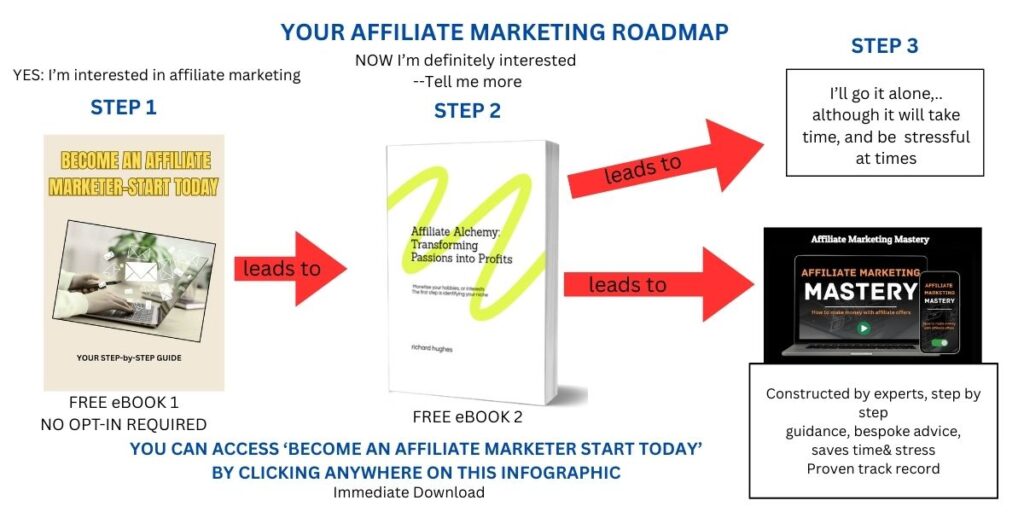
IF YOU HAVEN’T GOT YOUR OWN AUDIENCE YET, via email, blog or social media, CLICK ON THE INFOGRAPHIC BELOW TO START
IF YOU ALREADY HAVE A GOOD FOLLOWING, CLICK ON THIS INFOGRAPHIC