
Contents
- 1 How to Start Affiliate Marketing
- 2 What Is Affiliate Marketing?
- 3 How Affiliate Marketing Works (Step-by-Step)
- 4 How Affiliate Marketing Actually Makes Money
- 5 A Simple Affiliate Marketing Strategy for Beginners
- 6 Early Days of Affiliate Marketing
- 7 Step 1: Choose a Profitable Niche
- 8 Best Affiliate Marketing Niches for Beginners
- 9 Step 2: Best Platforms for Affiliate Marketing (Blog, Newsletter, YouTube, Social)
- 10 Affiliate Marketing for Beginners: What You Should Focus On First
- 11 Infographic Of An Affiliate Roadmap
- 12 Step 3: Join Affiliate Programs
- 13 Step 4: Create Conversion-Focused Content
- 14 Step 5: Drive Traffic Consistently
- 15 How Much Can You Make With Affiliate Marketing? (Realistic Example)
- 16 How Long Does It Take to Make Money With Affiliate Marketing?
- 17 Affiliate Marketing and Email Lists: Why Ownership Matters
- 18 Common Affiliate Marketing Mistakes That Kill Income
- 19 Affiliate Marketing vs Other Online Income Models
- 20 Affiliate Marketing Without a Website: Is It Possible?
- 21 Is Affiliate Marketing Legit?
- 22 Is affiliate marketing good for beginners?
- 23 How much money can beginners make with affiliate marketing?
- 24 Do I need money to start affiliate marketing?
- 25 Final Thoughts
- 26 Your Next Step
- 27 A Simple Affiliate Marketing Strategy for Beginners
- 28 Final Thoughts: Build Assets, Not Just Links
How to Start Affiliate Marketing
Affiliate marketing is one of the most popular ways beginners attempt to make money online — and one of the most misunderstood.
If you’re searching for how to start affiliate marketing, you’re likely wondering:
- Is affiliate marketing legit?
- Can beginners really make money?
- Do I need a website?
- How long does it take?
This step-by-step guide explains exactly how affiliate marketing works, how to start affiliate marketing as a beginner, and how to build it into a long-term second income — without hype or unrealistic expectations.
What Is Affiliate Marketing?
Affiliate marketing is a performance-based business model where you;
- Promote a product or service.
- Someone clicks your unique tracking link.
- They make a purchase.
- You earn a commission.
The beauty of the affiliate model is you don’t do ANY of the following;
- Create the product
- Handle fulfilment
- Manage customer service
- Process payments
You just have to focus on one thing:
Driving qualified traffic to trusted products.
How Affiliate Marketing Works (Step-by-Step)
Understanding how affiliate marketing works makes everything else easier.
At its core, the process is simple:
- You create helpful content around a specific topic.
- You include affiliate links to relevant products or services.
- A reader clicks your link.
- They make a purchase.
- You earn a commission.
That’s the mechanical process.
But successful affiliate marketing depends on three critical elements:
Targeted Traffic
Visitors must be interested in the problem your content solves.
Trust
People buy through creators they believe and respect.
Relevance
The product must match the reader’s need at the moment they encounter it.
Affiliate marketing is not about placing random links inside articles.
It’s about creating useful content that naturally connects readers with solutions.
When traffic, trust, and relevance align, affiliate income becomes predictable.
How Affiliate Marketing Actually Makes Money
The affiliate model works like this:
Traffic → Click → Conversion → Commission
Your income depends on:
- Volume of traffic
- Conversion rate
- Commission percentage
- Average order value
There are two main payout types:
One-Time Commissions; You earn once per sale.
Recurring Commissions; You earn monthly or annually for subscription products.
Recurring affiliate programs can build compounding income over time — especially when combined with an email list.
A Simple Affiliate Marketing Strategy for Beginners
Most people approach affiliate marketing as a collection of tactics.
Instead, think of it as a simple system:
- Choose a focused niche
- Create helpful, problem-solving content
- Drive targeted traffic
- Capture attention (ideally with an email list)
- Recommend relevant products
- Track results and refine
And basically that is it.
Affiliate marketing becomes powerful when you repeat this cycle consistently.
You are not trying to “go viral.”
You are building a small but growing ecosystem of content that:
- Attracts the right people
- Solves real problems
- Naturally introduces useful tools
- Over time, that system compounds.
- Without a system, affiliate marketing feels random.
- With a system, it becomes predictable
Early Days of Affiliate Marketing
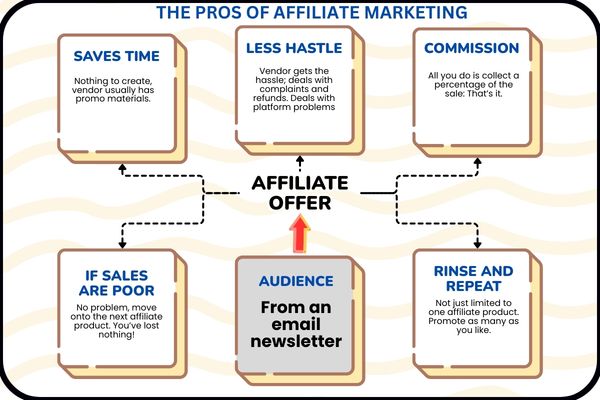
In the early days of affiliate marketing it was common for affiliates just to drive traffic straight to an affiliate link.
The vendor may then have ‘warmed up’ the traffic with a webinar, a set of emails, or a long sales page promoting the benefits of the product and if the sale was made the affiliate got a pay-out, or commision.
However, this model has it’s disadvantages in that;
- Many social media sites do not allow a simple click through straight to an affiliate site.
- BUT more importantly YOU do not own the traffic, the vendor does. Which means you can’t retarget them in the future.
Some people still use this model, but the model using your own email newsletter to OWN your list is so much better
Step 1: Choose a Profitable Niche
Random promotion rarely works.
Successful affiliate marketing requires:
- A defined audience
- A focused topic
- Clear problems to solve
Examples of strong niches:
- Online business tools
- Personal finance
- Fitness programs
- Software and SaaS
- Productivity tools
Your niche should align with long-term content creation.
If you’re already building a newsletter, choose affiliate products that serve that audience.
Clarity increases conversions.
Best Affiliate Marketing Niches for Beginners
Choosing the right niche is one of the most important decisions when starting affiliate marketing.
The best affiliate marketing niches typically have:
- Strong demand
- Ongoing product purchases
- Clear problems to solve
- Recurring or high-ticket offers
Some beginner-friendly examples include:
Software and SaaS
Tools for productivity, marketing, design, or online business.
Finance and Investing
Budgeting apps, financial platforms, and education resources.
Health and Fitness
Programs, supplements, and coaching services.
Online Education
Courses, memberships, and learning platforms.
Productivity and Personal Development
Apps, planners, and systems.
The ideal niche is one you can write about consistently for years — not weeks.
Affiliate marketing works best when your niche supports long-term content creation.
Step 2: Best Platforms for Affiliate Marketing (Blog, Newsletter, YouTube, Social)
You need a platform to build trust and distribute content.
Common options:
1. Blog (SEO-Based)
You create search-optimized content that ranks in Google.
2. Email Newsletter
You build an audience you own and recommend tools directly.
3. YouTube Channel
You review products and tutorials via video.
4. Social Media Platform
You build an audience and direct traffic to affiliate links.
The strongest long-term strategy combines:
SEO + Newsletter.
If you haven’t built your foundation yet, learn how to start a profitable newsletter and use it as your core asset.
Affiliate Marketing for Beginners: What You Should Focus On First
If you’re starting affiliate marketing as a beginner, ignore advanced tactics. You should focus on:
- One niche
- One platform
- One core content strategy
- One traffic source
Most beginners fail because they:
- Promote too many products
- Switch niches too quickly
- Expect income in the first month
- Avoid building an audience
Start simple. Build slowly. Refine consistently.
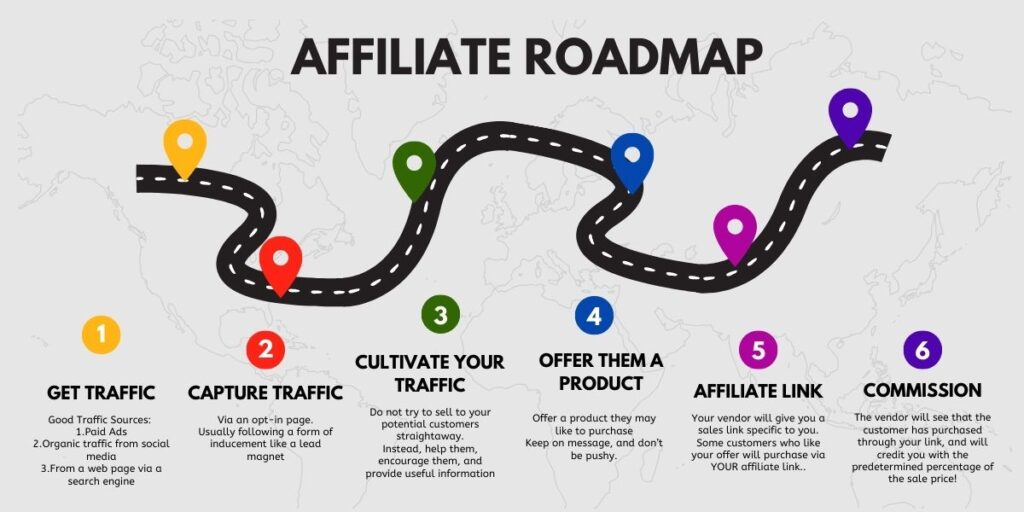
Infographic Of An Affiliate Roadmap
Step 3: Join Affiliate Programs
You can find affiliate programs in three ways:
Direct Brand Programs
Many companies run their own programs.
Affiliate Networks
Platforms that aggregate multiple brands.
Software & SaaS Programs
Often offer higher recurring commissions.
When evaluating programs, consider:
- Commission percentage-how much of the retail price do you receive
- Cookie duration-cookies that last for a long time are better. A cookie gives a ‘time window’ for the purchaser to purchase and you get the credit.
- Payment threshold
- Brand reputation
Promote products you trust.
Trust converts.
Step 4: Create Conversion-Focused Content
Affiliate marketing is content-driven.
High-performing content types include:
Product Reviews
In-depth, honest breakdowns.
Comparison Articles
“Tool A vs Tool B” posts.
Tutorials
Show how to use a product to solve a problem.
Resource Pages
Curated lists of tools you personally use.
Content should:
- Solve real problems
- Be transparent about affiliate links
- Prioritize value over promotion
The goal is long-term trust.
Step 5: Drive Traffic Consistently
Without traffic, affiliate marketing produces zero income.
There are four primary traffic sources:
SEO (Search Engine Optimization)
Long-term traffic asset.
Email Marketing
Direct access to your audience.
Social Distribution
Amplify your content.
Community Engagement
Forums, groups, niche platforms.
If you’re just starting, focus on:
One traffic source + consistency.
Avoid scattering your effort.
How Much Can You Make With Affiliate Marketing? (Realistic Example)
Affiliate income depends on simple math.
Let’s break down a basic scenario:
- 1,000 monthly website visitors
- 5% click your affiliate link (50 clicks)
- 4% of those convert (2 sales)
- Commission per sale: $75
That’s $150 per month from one page.
Now imagine:
- 20 similar pages
- Or a growing email list
- Or recurring commissions
The numbers scale with traffic and trust.
Affiliate marketing is rarely explosive at the beginning.
But with consistent content and growing traffic, income can compound steadily.
Focus first on building traffic and authority — not maximizing commission percentages.
How Long Does It Take to Make Money With Affiliate Marketing?
One of the most common beginner questions is:
“How long before I see results?”
Here’s a realistic breakdown:
Months 1–3:
Learning, publishing, and building foundational content. Income is usually minimal or zero.
Months 3–6:
Early traffic appears. Small commissions may begin.
Months 6–12:
Content compounds. Traffic increases. Income becomes more consistent.
Affiliate marketing rewards consistency.
The people who succeed are not necessarily the most technical — they are the ones who continue publishing when growth feels slow.
If you approach affiliate marketing with long-term thinking, small wins gradually turn into meaningful second income.
Affiliate Marketing and Email Lists: Why Ownership Matters
Many beginners rely entirely on:
- Social media reach
- Platform algorithms
- Search engine rankings
While those can work, they are not assets you control.
An email list changes everything.
When you combine affiliate marketing with a newsletter, you can:
- Recommend tools directly
- Build deeper trust
- Increase repeat exposure
- Earn recurring commissions
A small, engaged email list often converts better than large, passive traffic.
That’s why building an audience you own — such as through a newsletter — strengthens your affiliate strategy dramatically.
Traffic builds exposure.
Email builds leverage.

Download Your Free eBook ‘Start Your Own Newsletter Today’
Download is Instant-NO email required
The perfect start to your profitable email newsletter journey
Common Affiliate Marketing Mistakes That Kill Income
Promoting Too Many Products
Beginners often promote everything they come across. This reduces trust and weakens positioning. Focus on a small set of high-quality tools that genuinely help your audience.
Chasing High Commission Rates
A 50% commission on a poor product converts worse than a 20% commission on a trusted solution. Conversion rate matters more than percentage.
Ignoring Audience Trust
Affiliate marketing is not about links — it’s about credibility. If your audience feels you promote products only for commissions, conversions will decline.
Not Building an Email List
Relying only on search or social traffic limits long-term leverage. An email list increases repeat exposure and multiplies earning potential.
Expecting Fast Results
Affiliate marketing compounds over months, not days. Many beginners quit just before their content gains traction.
Avoid these mistakes, and your affiliate marketing efforts become far more sustainable.
Affiliate marketing rewards patience and positioning.
Affiliate Marketing vs Other Online Income Models
Affiliate marketing ;
Has a low start-up cost
means no product creation
Is easy to scale with content
Compared to:
Digital products – higher margins, more work
Courses – higher revenue, more responsibility
Sponsorships – audience dependent
Affiliate marketing works especially well as:
A first income layer attached to content.
It can later support:
- Course launches
- Premium memberships
- Consulting
Think of it as your monetization foundation.
Affiliate Marketing Without a Website: Is It Possible?
Yes — you can start affiliate marketing without a website.
Many beginners use:
- A YouTube channel
- A newsletter
- Social media platforms
- Online communities
However, there are trade-offs.
Without a website, you depend heavily on:
- Platform algorithms
- Account stability
- Limited control over visibility
A website provides:
- Long-term SEO traffic
- Greater control
- Higher scalability
- Asset ownership
For serious long-term income, combining a website with an email list is one of the strongest strategies.
You don’t need a website on day one — but it becomes increasingly valuable as you grow.

Is Affiliate Marketing Legit?
Yes.
Major brands run affiliate programs.
However, like any business model, it requires:
- Strategy
- Traffic
- Trust
- Consistency
It is not passive income on day one; It is asset-based income over time.
Is affiliate marketing good for beginners?
Yes. Affiliate marketing is beginner-friendly because you don’t need to create products or manage inventory. However, it requires consistency and traffic-building skills.
If you are a total beginner and want to know more go here.
How much money can beginners make with affiliate marketing?
Beginners often earn their first commissions within a few months, but meaningful income typically takes 6–12 months of consistent effort.
Do I need money to start affiliate marketing?
You can start with minimal cost using free platforms, but investing in a website and email list improves long-term results.
Final Thoughts
Affiliate marketing is not about chasing commissions.
It is about:
- Building trust
- Creating useful content
- Solving real problems
- Connecting people with the right solutions
Approached correctly, it becomes a scalable second income layer attached to your digital assets.
Start simple.
Choose a niche.
Pick a platform.
Publish consistently.
Refine over time.
Then build momentum.
Your Next Step
If you haven’t built your audience yet, begin by creating your first core asset:
👉 Read the complete guide on how to start a profitable newsletter.
Build attention first.
Monetize second.
That’s how affiliate marketing compounds.
There’s a lot to take in there in one go. So here’s a logical way to approach the subject of affiliate marketing.
A Simple Affiliate Marketing Strategy for Beginners
Here is a flow model you can use.:
- Choose niche
- Create helpful content
- Build traffic
- Capture email
- Recommend relevant products
- Track & refine
Final Thoughts: Build Assets, Not Just Links
Affiliate marketing is not a shortcut.
It is a business model built on:
- Trust
- Traffic
- Consistency
- Long-term thinking
The people who succeed are not necessarily the most technical.
They are the most consistent.
If you want affiliate marketing to become a meaningful second income, focus first on building an audience and creating valuable content.
Start with one niche.
One platform.
One strategy.
Then execute for six months without distraction.
That’s how affiliate income compounds.